The stories from World War II up close
Challenge
There are increasingly fewer eyewitnesses of the Second World War able to share their stories. For this reason, the WO2Net Foundation aims to make the dispersed sources on the war more easily discoverable and usable in digital form. The stories hidden in archives are of great importance not only for the present but also for future generations. By passing these on digitally, the WO2Net Foundation seeks to ensure that the lessons of the Second World War continue to serve as a moral benchmark in the future.
Result
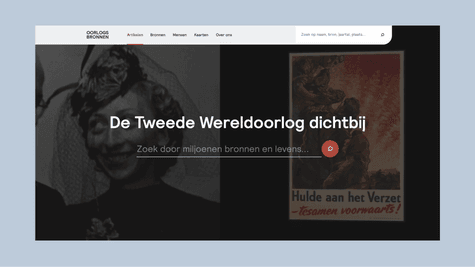
Oorlogsbronnen.nl connects and enriches millions of sources by linking them to events, locations, individuals, and themes. The platform is almost entirely data-driven, using data to generate rich content pages with meaningful interconnections.
The first release of the platform took place in 2020. In the years that followed, it has been continuously expanded and further developed. In 2025, it underwent a complete redesign, encompassing technology, design, and user experience. The stories of the war come vividly to life through detailed biographies, animations, and contextual sources that bring history closer than ever.
What we did
Concept, data driven storytelling, digital identity, UX design, development
Impact
Awards
- Dutch Interactive Award: Data
- Dutch Interactive Award: Content
- Dutch Interactive Award: Service
- The Lovie Awards: Cultural Institutions
- The Lovie Awards: Beste Use of Data Visualisation
- The Anthem Awards: Humanitarian Action & Services
Co-creation
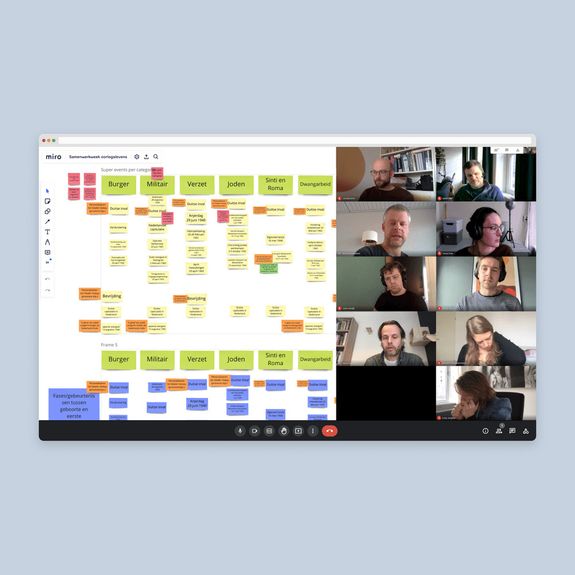
In multiple online co-creation sessions, our strategists, developers, and designers collaborated with the knowledge scientists from the WO2Net Foundation and data scientists from Spinque on the development of the platform. By working together across different disciplines, we were able to transform complex data into actionable information and deliver an optimal user experience.
We regularly conduct research with our users to ensure we continue to meet their needs in bringing the sources and stories of the Second World War closer to them. This year, we also carried out an extensive target audience study. Based on its findings, we made significant improvements to the website.
Data-driven
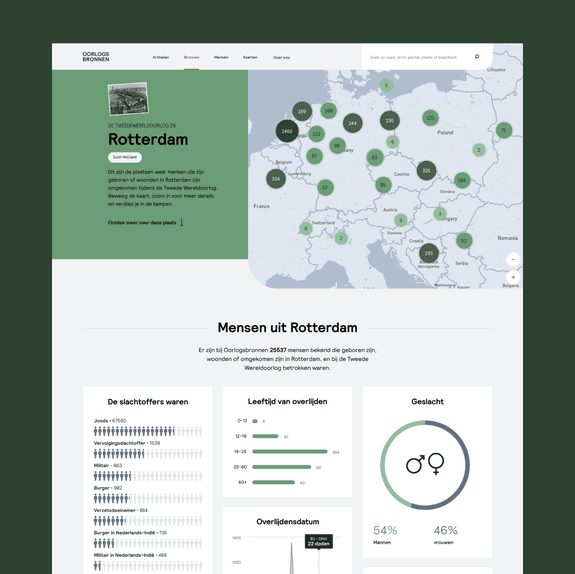
The platform is almost entirely data-driven and automatically grows alongside new datasets and collections. Thanks to reusable components, the system remains well-organised, no matter how large the data sources become. During further development, we migrated from Drupal to the modern Sanity CMS, making management simpler than ever. With an intelligent import tool, all existing stories were automatically included.
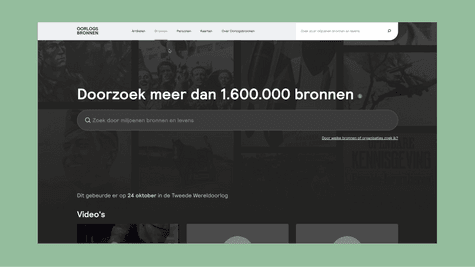
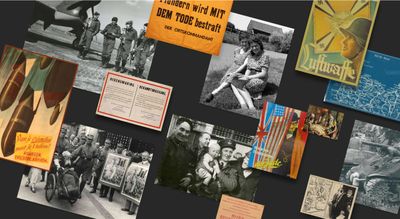
The platform provides context for more than 1.6 million sources by linking them to 750,000 individuals, thousands of locations, themes and events.
Search design
Through Linked Open Data, advanced search strategies and an extensive Knowledge Graph, semantic connections are created between the sources. For example, we can precisely determine where a person was during a particular event and what their role was. The redesigned search function makes these connections even more visible: users can now filter more easily by theme, source, or location to find relevant information faster. Searching by place of birth or death is also now possible. In addition, the search experience aligns with the NDE guidelines, including behavioural profiles for targeted information searching, browsing and discovery. These profiles form an important foundation within the heritage sector and contribute to an accessible and intuitive way of searching.
The lives of over 750,000 individuals
One of the ways we provide context is by giving over 750,000 individuals their own data-generated life timelines. Using names and events, the lives of those affected by the war are reconstructed. The redesigned individual pages present these timelines in a more narrative and accessible way, complete with source references and links to external archives. Through crowdsourcing, visitors can add their own photos or crop existing portrait images, making the collection increasingly complete and personal. Thanks to this interactive and narrative approach, the lives of individuals come vividly to life, while the historical context remains accessible and clear.
In the media
The platform’s launch was highlighted by NOS Journaal, showcasing how it helps both scholars and the general public discover more about the Second World War. The focus was on combining different WWII sources, generating new data and insights about events and the lives of people during the war.
Awards
The narrative power of Oorlogsbronnen.nl has not gone unnoticed. The platform has been awarded multiple Dutch Interactive Awards, Lovie Awards, and an Anthem Award. These accolades highlight how data and design can come together to create meaningful stories. Stories that not only reconstruct history but also contribute to awareness and remembrance.
Credits: Spinque voor search design, knowledge graph en development search engine.
Ready to change things?